
Chapter 21
Lesson 1
- Adherence: The level of commitment to a behavior or plan of action
- Overtraining: Excessive frequency, volume, or intensity of training, resulting in reduction of performance, which is also caused by a lack of proper rest and recovery
- Kinetic chain: A concept that describes the human body as a chain of interdependent links that work together to perform movement.
- Iceberg effect: Exercise programming involves more than what we see at the surface, such as reducing body fat, gaining muscle mass, or increasing strength and power (Teyhen et al., 2014)
- Training plan: The specific outline created by a fitness professional that details the form of training, length of time, future changes, and specific exercises to be performed.
- Acute variables: Important components that specify how each exercise is to be performed; also known as exercise training variables.
- Periodization(or planned fitness training): Macromanagement or planned manipulation of training variables in an organized fashion to improve performance over time.
- Macrocycle: annual training plan
- Mesocycle: monthly training plan (4-6 weeks)
- Microcycle: weekly or daily training plan (7-10 days)
- Periodization can be divided into three(3) distinct phases that lead up to competition: (1) preparatory, (2) competitive, and (3) transition.
- Preparatory: aims to gradually increase volume and intensity of training to peak levels prior to the competitive season
- Competitive: the competition (in-season) period, and the aim is to keep athletes in top condition while minimizing overtraining and burnout
- Transition(off-season): the point where a competitive phase ends, and the athlete begins to incorporate active rest and tapers down the intensity of workouts
- Linear periodization: A traditional method of program design that aims to gradually increase the intensity of the training load while simultaneously decreasing volume over a set period of time.
- Hypertrophy: Enlargement of an organ or tissue; in the context of fitness, it is often used to describe the enlargement of skeletal muscle.
- Undulating periodization: A programming scheme, also known as nonlinear periodization, that uses changes in volume, intensity, and exercise selection to provide loading differences on a daily or weekly basis.
Lesson 2
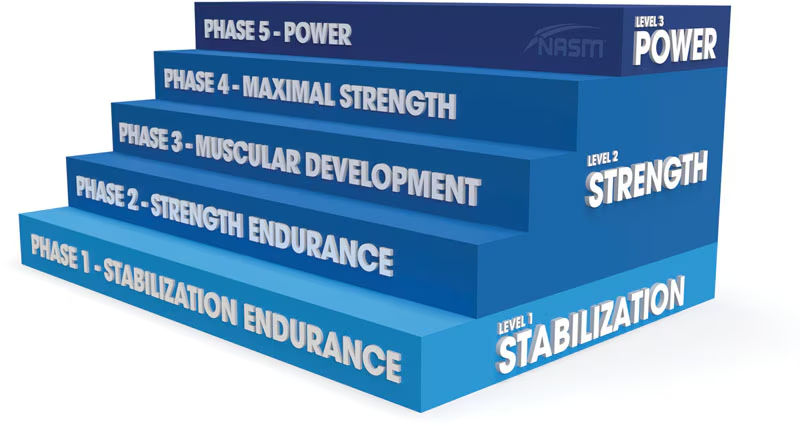
- Three distinct levels of OPT model: (1) stabilization, (2) strength, and (3) power.
- Five unique phases of training
| Level | Phase | Primary Adaptations | Primary Methods of Progression |
| Stabilization | 1. Stabilization Endurance Training | – Mobility and flexibility – Core and joint stabilization – Postural alignment and control – Muscular and aerobic endurance | – Master basic movement patterns. – Progress exercises proprioceptively (controlled, yet unstable) once basic movement patterns are established. – Increase the complexity of exercises once basic movement patterns have been established. |
| Strength | 2. Strength Endurance Training | – Core strength and joint stabilization – Muscular endurance and prime mover strength | – Decrease rest periods. – Increase the volume of exercises (reps + sets). – Increase the load (weight) of resistance training exercises. – Increase the complexity of resistance training exercises. |
| Strength | 3. Muscular Development Training | – Core strength – Maximal strength and hypertrophy | – Increase the volume of exercises. – Increase the load of resistance training exercises. – Increase the complexity of resistance training exercises. |
| Strength | 4. Maximal Strength Training | – Core strength – Maximal muscular strength | – Increase the load of resistance training exercises. – Increase the sets of resistance training exercises. |
| Power | 5. Power Training | – Core strength – Maximal muscular strength – Rate of force production | – Increase the load of resistance training exercises. – Increase the speed (repetition tempo) of exercises. – Increase the sets of exercises. |
- six(6) parts from warm-up through cool-down(six parts of OPT programming template): (1) Warm-Up, (2) Activation, (3) Skill Development, (4) Resistance Training, (5) Client’s Choice, and (6) Cool-Down
- Autonomy: Acting in accordance with how one wants to behave.
- Self-efficacy: One’s belief that he or she can complete a task, goal, or performance; also known as self-confidence.
- Length-tension relationship: The resting length of a muscle and the tension the muscle can produce at this resting length.
Lesson 3
- Fundamental movement patterns: Common and essential movements performed in daily life and are involved in exercise motions within a training session.
- Activities of daily living (ADL): The fundamental tasks needed to manage basic self-care activities, such as bathing, dressing, grooming, meal preparation and feeding, and homemaking.